Wednesday, December 3, 2025

Best Practices for Resumes in 2025


By Bridget (Weide) Brooks

The job search landscape evolves quickly — and so should resumes. Whether you're a professional résumé writer striving to keep client documents cutting-edge, or a jobseeker looking to stay competitive in today’s hiring environment, staying aligned with current best practices is essential. These 2025 guidelines reflect what employers and recruiters expect right now, and how to make sure your resume stands out in the modern job market.

  • Eliminate the Excess

A resume isn’t a jobseeker’s life story (or “career obituary”) — it’s a marketing document. Focus on the most relevant, recent experience (generally the past 10–15 years). Two pages is the sweet spot for most professionals. Cut outdated or unrelated details so hiring managers can quickly see what makes the jobseeker the right fit.

  • Lead With a Personal Brand Statement

Open with a concise summary that captures who the candidate is, what they do best, and the value they have to offer to the next employer. This 3-4 sentence section is prime real estate — make it count by showcasing the jobseeker’s professional identity and unique strengths.

  • Demonstrate Continuous Learning

Employers want adaptable, growth-minded professionals. Include certifications, workshops, or online courses that show the jobseeker’s commitment to professional development — especially in rapidly changing fields like technology, marketing, and healthcare.

  • Focus on Accomplishments, Not Tasks

Modern resumes highlight impact, not job descriptions. Lists of duties should be replaced with bullet points showing measurable results, skills, and contributions. For example:
“Led a 25-member cross-functional team that redesigned a 200-page SOP manual, improving efficiency by 30%.”

  • Quantify Results

Numbers catch the eye and build credibility. Use metrics (percentages, dollar amounts, headcounts, timelines) to demonstrate performance and results. Quantifying achievements gives hiring managers a clear sense of the jobseeker’s impact.

  • Highlight Remote or Hybrid Work Experience

If the candidate has successfully worked remotely, show it. Mention tools used (Zoom, Slack, Trello, Microsoft Teams) and emphasize communication, collaboration, and self-management skills. Employers value proven remote-work proficiency, even in today’s hybrid and back-to-the-office environments.

  • Tackle Employment Gaps with Intention

Gaps happen. How you present them matters. If the jobseeker took time off, note relevant activities like freelancing, volunteering, or professional development. A brief explanation can prevent assumptions and show continued engagement.

  • Add Digital Links

Enhance the resume with links to a LinkedIn profile, digital portfolio, or personal website. Interactive elements — like QR codes — allow employers to explore work samples, certifications, or media features with one click.

  • Design for Humans and Machines

While Applicant Tracking Systems (ATS) remain important, remember that a real person will eventually review the resume. A clean, visually appealing design with subtle color and strong formatting can set a candidate apart — as long as readability remains top priority.

  • Optimize for ATS

More than 70% of employers (and nearly all Fortune 500 companies) use ATS to screen candidates. Use standard section headings, consistent formatting, and industry-relevant keywords to ensure the resume passes the initial scan.


Bonus Tip: Don’t Let AI Do All the Talking

AI tools can help tailor cover letters and resumes, but resist the temptation to copy-and-paste. Review every AI-generated draft carefully — personalize it, add the jobseeker’s authentic voice, and incorporate specific details that show genuine interest and expertise. Recruiters can spot a generic AI letter a mile away.


A well-written resume remains one of the most powerful tools in your professional toolkit — whether you’re crafting them for clients or fine-tuning your own. By staying current with resume trends and technology, you’ll position yourself (and your clients) to stand out in a competitive 2025 job market.


Bridget (Weide) Brooks is the founder and editor of Resume Writers’ Digest, a publication for career industry professionals. Since 1999, she has helped resume writers and career coaches grow their businesses and serve clients more effectively. Bridget also operates BeAResumeWriter.com, offering training and resources for career pros.

Follow her on LinkedIn or visit BeAResumeWriter.com for more resources.

Monday, October 27, 2025

How Many Professional Resume Writers Are There in the United States? (2025 Analysis)


How many professional resume writers are currently working in the United States?

This is something I’ve been tracking for the past 20+ years, so when I saw a statistic recently that claimed there are more than 289,000 resume writers in 2025 in the U.S., I was curious about how this number was calculated.

(To prove I’ve been tracking this for a long time, here is my blog post from 2009 answering the same question of how many resume writers there are in the United States: https://rwdigest.blogspot.com/2009/05/analyzing-professional-resume-writing.html)

If you’re a professional resume writer, the 289,000 number is dramatic and a little alarming — especially if you’re a career pro trying to stand out in what suddenly sounds like an insanely crowded market. (And I really respect the person who quoted that number, but I have no idea where the data came from.)

Here’s the problem: the 289,000 number doesn’t line up with any credible data from professional associations, industry directories, or actual labor structure in our field. In fact, the most supportable, evidence-based estimate of the number of professional resume writers is approximately 7,000-8,000.

Let’s walk through why.

What do I mean by “professional resume writer”?

First, definitions matter.

For the purpose of this discussion, a “professional resume writer” means:

  • Someone who sells resume development as a service (not just as a favor to friends).
  • Someone who is either full-time or part-time in resume writing or closely related career marketing services (resumes, LinkedIn profiles, career documents, etc.).
  • Someone who can reasonably be identified in the market (website, business listing, professional association, agency rosters, etc.).

I’ve also used the metric in the past of someone who writes at least one resume per month. That helps include “future career pros” — people who are writing resumes on the side.

This excludes:

  • Jobseekers who happen to be good writers.
  • Corporate HR staff who occasionally rewrite resumes for friends and family and coworkers.
  • AI resume template generators.
  • “I’ll do your resume for $5” listings from anonymous accounts (that may or may not be U.S.-based) on freelance websites

When we’re talking about people who have built a business around resume writing — whether that’s a solo practice, a boutique firm, or a writer working for an outplacement agency — that’s the group we’re trying to count.

What credible data do we actually have?

Here are the four most reliable data points available right now from public-facing sources and industry research:

  1. Professional Associations

  • The Professional Association of Resume Writers & Career Coaches (PARWCC) reports “more than 3,000 members,” and in some materials notes that it “boasts over 2,800 members.” PARWCC is a U.S.-founded credentialing and membership body for resume writers and career coaches.
  • The National Resume Writers’ Association (NRWA) positions itself as a professional association “representing resume writers,” and refers to “500+ professional resume writers,” primarily U.S.-based.
  • That doesn’t count the members of other professional associations, such as Career Thought Leaders or Career Directors International, but many career professionals belong to multiple associations. (The “average” professional resume writer belongs to one or more professional associations, according to the Profile of Professional Resume Writers data.)
  • Career Thought Leaders (CTL) and Career Directors International (CDI) both present themselves as curated professional communities of resume writers, career coaches, and related career experts. Neither publishes a big “tens of thousands of members” claim; based on their directories and positioning, they appear to be in the hundreds to low thousands each, globally.

These are not hobbyists. These are people paying dues, pursuing certification, investing in training, and marketing themselves as resume professionals. (Maybe I should add those criteria to define a “professional resume writer.”)
  1. Industry classification

    • IBISWorld tracks “Resume Writing & Editing Services in the US” as its own industry segment (industry code 6544), which is our first clue that resume writing is established enough to be considered a defined service niche in the U.S. economy.

    • Industry reports generally count firms and revenue, rather than individual resume writers, but it confirms that resume writing isn’t just an informal side hustle. It’s a recognized business category.

  2. Business directories

    • A B2B intelligence directory (ensun.io) lists roughly 3,768 “suitable service providers” in the United States under the category of “resume writing.” These are businesses, not just individual people. That includes one-person shops, boutique resume-writing firms, agencies that employ multiple writers, and outplacement-style services.

  3. Marketplace structure

    • Most resume-writing businesses in the U.S. are very small: solos, partnerships, and small boutique firms. A handful of higher-volume agencies employ teams of writers or subcontractors. This structure matters, because it gives us a way to estimate headcount.

Let’s estimate the actual number of resume writers.

If there are approximately 3,768 resume-writing service providers in the U.S. right now, how many individual resume writers does that represent?

Here’s a conservative, industry-aligned model:

  • About 70% of providers are solo practitioners — one resume writer doing all the client work.

    70% of 3,768 is about 2,638 companies, representing ~2,638 individual writers.

  • About 25% of providers are boutique firms with 2-5 writers.
    25% of 3,768 is about 942 companies.

    If we assume an average of 3 resume writers per boutique firm, that gives us ~2,826 writers.

  • About 5% of providers are larger agencies or outplacement firms with teams of writers (6-20+ writers, sometimes more).

    5% of 3,768 is about 188 companies.

    If we assume an average of 10 resume writers per agency, that adds ~1,880 writers.

Now add those three tiers:

  • 2,638 (solo writers)
  • 2,826 (boutique writers)
  • 1,880 (agency writers)

2,638 + 2,826 + 1,880 = 7,344

That gives us an estimated ~7,300 active resume writers in the United States.

Even if you adjust assumptions up or down a bit — maybe some “boutiques” actually only have two writers, or some high-volume firms use 20+ writers — you’re still generally in the single-digit thousands — or even 15,000 to 20,000, not hundreds of thousands.

So a grounded, defensible way to answer the question “How many professional resume writers are in the U.S.?” is: Approximately 7,000 to 8,000.

Why “289,000 resume writers in the U.S.” is almost certainly wrong

Let’s test that “289K+” claim against reality.

Claim: there are 289,000 resume writers in the U.S. in 2025.

Problem #1: Association numbers don’t support it.
Even the largest, longest-running U.S.-based association of resume writers (PARWCC) cites membership in the 2,800-3,000 range. The NRWA cites “500+ professional resume writers.”

“Career Thought Leaders (CTL) and Career Directors International (CDI) also serve the resume writing & career coaching industries. Neither publishes a verified total member count, but both appear to serve several hundred to maybe a few thousand practitioners — rather than tens of thousands. This further supports the estimate that there are around 7,000-8,000 professional résumé writers in the U.S.

If there were truly 289,000 U.S. resume writers, why are only around 3,000 of them showing up in the biggest, most visible associations in the field? That would imply that more than 98% of U.S. resume writers are totally invisible to the known professional infrastructure. That’s unlikely.

Problem #2: The business footprint doesn’t support it.
We do not see 289,000 active resume-writing businesses. We see on the order of 3,700 U.S. providers.

For the 289,000 figure to be true, each “provider” would need to employ, on average, more than 75 resume writers. That does not reflect how resume-writing firms actually operate. A typical resume-writing business is not a 75-writer operation. It’s a one- to three-writer operation. (Mostly one writer, as the Profile of Professional Resume Writers data over the last 20 years supports.)

Problem #3: Labor visibility doesn’t support it.
If there were truly 289,000 resume writers in the U.S., resume writing would be as common as real estate licensure and as visible as tax prep — there would be resume writers at every networking breakfast, every chamber of commerce lunch, every co-working space, every PTA fundraiser. You would already know five personally. You don’t, and neither does anyone else outside of our industry.

Problem #4: “U.S. only” is almost certainly mislabeled.
One common way to inflate these numbers is to count every freelancer on every major global platform (Upwork, Fiverr, Freelancer.com, PeoplePerHour, etc.) who lists resume or CV writing anywhere on their profile, and then to call that “U.S.-based resume writers.”

But those marketplaces are heavily international. Many of those accounts are not in the U.S., not focused on resume writing as their core business, and not consistently active.

It’s very easy to scrape a big global number and then (intentionally or accidentally) tag it as “U.S. only” to make a point about market saturation.

Why marketers like the “289K” narrative

Let’s be honest: “There are 7,000-8,000 real competitors in the U.S.” sounds manageable.

“There are 289,000 competitors in the U.S.” sounds terrifying.

Which version is better at selling you a $2,000 training program, certification add-on, or “stand out in a crowded market” bootcamp?

Big, scary numbers create urgency. Urgency sells. That doesn’t mean the numbers are true.

Resume writer vs. “someone who will touch your resume for money”

There’s an important distinction here that gets blurred on purpose.

A professional resume writer:

  • Has an established practice (business entity, brand, pricing, intake process).
  • Sells resume creation/revision as a defined service, often alongside LinkedIn profiles, cover letters, and career marketing documents.
  • Often invests in training, certifications, conferences, continuing education, or peer review.
  • Does this repeatedly, for paying clients, with some kind of methodology and expected outcome.

Someone who “also writes resumes”:

  • Might be a general copywriter, virtual assistant, HR coordinator, or graphic designer.
  • Might have done two resumes ever. Or two a year.
  • Might list “resume help” on Fiverr next to “I’ll design your logo” and “I’ll proofread your blog.”
  • Might not be in the U.S. at all, even if they market to U.S. jobseekers.

Both groups technically “offer resume writing,” but they are not the same thing in terms of expertise, volume, methodology, or client outcomes.

When someone throws out a six-figure number like “289K resume writers,” what they’re often doing is counting everyone in that second bucket — anyone, anywhere, who, for any price, will touch a resume. Then they present that number as if all of those people are your direct professional peers. They’re not.

So… what’s the real answer?

Based on:

  • Association membership (PARWCC ~2,800-3,000; NRWA 500+).
  • Industry recognition of “Resume Writing & Editing Services in the US” as a defined service niche.
  • Approximately 3,768 U.S. resume-writing service providers identified in business directories.
  • A realistic staffing model of solos, boutique firms, and multi-writer agencies.

A credible estimate is: There are roughly 7,000 to 8,000 professional resume writers working in the United States.

That is the number you can responsibly cite when you talk about our industry. Not 289,000. Not “hundreds of thousands.” Not “everyone and their cousin is now a resume writer.”

Seven to eight thousand.

That’s still a competitive market. But it’s not an unmanageable one — especially if you’re doing high-quality, strategy-driven work that’s hard to replicate with a $15 gig and a template.

In other words: resume writing is not a commodity by default. It’s a craft. And there are far fewer true practitioners than the number cited would have you believe.

Monday, August 11, 2025

Profile of Professional Resume Writers: The “Average” Resume Writer (Circa 2025)

Who are resume writers? 

For the past 20+ years, I’ve been surveying my professional resume writer colleagues to paint a portrait of the industry. This infographic gives a snapshot of the “average” resume writer:


She (most respondents identify as female), has been writing résumés for over 15 years, primarily as a self-employed, full-time professional. She holds certifications in résumé writing and/or career coaching and is a member of professional associations, such as Career Thought Leaders (CTL), the National Résumé Writers’ Association (NRWA), Career Directors International (CDI), BeAResumeWriter.com, and/or the Professional Association of Résumé Writers and Career Coaches (PARWCC). 
 
Her primary client sources are referrals from past clients, LinkedIn, and her website, reflecting her established reputation. (Newer writers may rely more on organic web searches, networking, and social media to build their client base.) She spends approximately 16 hours per week on résumé development, including consultations, research, and writing. She completes 1-3 résumés weekly, with each project taking 5-10 hours. She works 30-40 hours per week total, including administrative tasks, marketing, and networking.
 
Her standard package includes a résumé, cover letter, and often LinkedIn profile development, with an average sale price of $951. She typically speaks with prospects before closing sales and collects full payment upfront. She gathers client information using a combination of questionnaires and phone or virtual interviews.
 
Her challenges include inconsistent revenue, dealing with administrative tasks alone, client management, and the writing process itself. Emerging concerns involve adapting to artificial intelligence (AI) and competing with low-cost résumé mills. Mentally, she grapples with isolation, burnout, and occasional imposter syndrome, seeking stronger connections with peers to mitigate those feelings.

The Résumé Writers’ Digest Industry Survey is an opportunity for résumé writers to benchmark their progress compared to their peers. The survey was first conducted in 2001, and because it hasn’t been faithfully conducted each year, the word “annual” has been removed from the name of the survey. Also, due to the small sample size and voluntary participation, this is not a scientific surveyHowever, the results can be informative, giving you a peek into how other résumé writers work and offering ideas for increasing your income.


The 2025 Résumé Writers’ Digest Industry Survey was conducted in April 2025, asking respondents to look back at 2024. The results were compiled in July 2025. Sixty-five résumé writers took the anonymous survey, answering 28 questions. 


Wednesday, April 2, 2025

Navigating a Post-DOGE Job Search: A Guide for Federal Workers and Contractors


New Guide for Federal Workers and Contractors Helps Navigate a Post-DOGE Job Search 

Two veteran career industry professionals have teamed up to create a “get started” guide for more than 1 million employees who are impacted by the Department of Government Efficiency’s (DOGE) plan to eliminate federal jobs and contracts. The stated goal of DOGE is to reach $1 trillion in savings by the start of the 2025-26 fiscal year that begins on Oct. 1.


The 40-page guide, “Solutions for Starting Your Federal Career Transition,” is designed for federal workers who have already been laid off or terminated, or who may be separated from their employment in the near future. It also is a resource for employees of companies with federal contracts who are affected by contract cancellations. 


The federal government is the nation’s largest employer. As of November 2024, there were an estimated 3 million federal employees (including US Postal Service employees) across the United States, excluding military personnel. In addition, there are more than 3.5 million federal contractors who aren’t counted as federal employees, but whose employment is affected by government contracts. Over the past week, multiple government agencies have cut 121 contracts worth $350 million, according to DOGE.


Tens of thousands of jobs have already been eliminated across numerous federal agencies. Most government workers (92%) are considered white collar workers. The website Layoffs.fyi estimates more than 113,000 federal employees have been fired or voluntarily resigned (on the condition they would be paid through the end of September). Mass layoffs were announced Tuesday at the Department of Health and Human Services, with 10,000 employees expected to be let go.


The federal government layoffs are expected to be the biggest from a single employer in history. IBM previously had that title, laying off 60,000 workers in 1993.


The guide is designed to cover the basics of getting started with a post-federal employment job search, including accessing federal employment-specific transition services, translating ‘fed speak’ into corporate language for a private-sector resume, and providing details about common job search scams to help federal jobseekers avoid being scammed. 


About the Authors:

Nancy H. Segal is the owner of Solutions for the Workforce. She started the business following her 30-year career in human resources with the federal government. She has extensive experience as a resume writer and career coach, with emphasis on federal jobs. Her certifications include Master Career Director (MCD), Certified Master Resume Writer (CMRW), Certified Professional Resume Writer (CPRW), Certified Federal Resume Writer (CFRW) and Job and Career Transition Coach (JCTC). 


Ellen Steverson opened StartingBlock Career Services, LLC in 2011. She is a Nationally Certified Resume Writer (NCRW), Nationally Certified Online Profile Expert (NCOPE), Certified Employment Interview Consultant (CEIC), and Global Career Development Facilitator (GCDF). She has written more than 1,000 resumes and coached hundreds of people on job search and interview preparation.


The guide is $7.49 and can be ordered here:

https://sftwshop.com/products/solutions-for-starting-your-federal-career-transition


Thursday, January 9, 2025

The AI-Savvy Job Seeker


Happy Publication Day to Michelle Dumas!

Her new book, “The AI-Savvy Job Seeker: Transform Your LinkedIn Profile and Outshine the Competition” is available today as a Kindle book ($7.99) and paperback ($15.99) — and here’s why you should check it out!

I had a chance to read a pre-publication version of the book (and provide a blurb for the foreword!) and here’s what you’ll get in the jam-packed-but-easy-to-read 313-page guide:
  • A holistic approach to improving a client’s LinkedIn profile using AI prompts
  • The EXACT prompts to plug into your AI tool to help you or your client improve their LinkedIn profile
  • Prompts to help you — or your client — create an effective networking strategy
  • Practical advice for how to use LinkedIn effectively in a job search
Here’s what I had to say about it for the foreword:

I’ll be recommending “The AI-Savvy Job Seeker” to all my clients and career industry colleagues. While there has been a lot of talk about how artificial intelligence can help in the job search, this book provides clear, actionable insights. With accessible strategies for everyone from recent college graduates to seasoned executives, the book combines detailed explanations about the WHY of the strategy with the WHAT of how to implement the idea, including specific AI prompts. The blueprints to create an effective “About” section are pure gold for populating this key LinkedIn section. This book is an essential resource for anyone looking to leverage AI in their job search.

If you purchase the Kindle, you'll get instant access. I had pre-ordered it and am reading it again today! I’ve already put some of the tactics into action with one of my clients! 

Check it out.

Michelle is also the creator of Distinctive Resume Templates


Links in this post are affiliate links, meaning I may receive an affiliate commission if you take action based on my recommendation. Don’t worry, though, I *only* recommend resources that I either personally use or would unequivocally recommend.

Thursday, December 19, 2024

A Resume Writer By Any Other Name…


Looking for alternate job titles for “Resume Writer” for your LinkedIn profile?

Here are some suggestions:

  • Career Consultant
  • Career Development Specialist
  • Career Development Coach
  • Career Strategy Consultant
  • Career Storyteller
  • Career Growth Strategist
  • Job Success Specialist
  • LinkedIn Profile Expert
  • Job Market Advisor
  • Senior Resume Writer
  • Career Services Consultant
  • Resume Optimization Specialist
  • Executive Resume Specialist
  • Career Coaching Expert
  • Job Search Coach
  • Job Search Consultant
  • Job Search Strategist
  • Interview Preparation Advisor
  • Interview Coach
  • Job Market Specialist
  • Job Search Advisor
  • Job Application Specialist
  • Personal Branding Expert
  • Professional Bio Creator
  • Client-Focused Consultant
  • Professional Resume Writer
  • Resume Project Manager
  • Career Transition Specialist

Monday, November 18, 2024

Mindset Monday: Avoiding Imposter Syndrome


You’ve worked hard, you’ve taken the courses, you’ve learned and experienced a lot — but somehow it all just doesn’t feel real. Whenever you are praised for your skills, talents, or accomplishments, you feel fearful that you will be exposed as a fraud — even though you are obviously not a fraud. 

 
This, my friend, is imposter syndrome. Sadly, this psychological syndrome affects women at a higher rate than men, but it exists in all sexes in all classes. About half of all people experienced imposter syndrome at one time or another, according to one poll. 
 
If you suffer from this syndrome, it’s important to recognize it and work toward eradicating it from your life. In fact, recognizing it is the primary key to fighting it.

  • Retrain Your Thoughts. If you ever think things like, “this was all luck” about your success, it’s time to retrain your thoughts. Instead of thinking that, go over the reasons you could do what you did. It was more than likely due to the experience, education, and action you took. 
  • Assign Value. When you can verify or quantify the value that you provide to others, then you can help your mind accept that what you do is valuable and not a matter of just luck. Record data about the impact your work does for people. (Number of interviews generated, jobs you’ve helped them achieve, salary increases, etc.)
  • Get Professional Help. If none of the advice given helps, you can go to a therapist or find a life coach to help you overcome imposter syndrome. Many counselors are trained in this syndrome, and many life coaches are very aware of it and now know to help you overcome it.

Imposter syndrome can cause you to miss opportunities because you think you’re not ready for it. There are many people out there doing what you want to do and doing it poorly without any issues. You’re an expert, and no matter how much you try to talk yourself out of it, you have the expertise and deserve the kudos that you get. 

Friday, September 27, 2024

Career Industry Conference Update: 2024


This year (2024) marks the 25th anniversary of my first resume writing conference appearance (the 1999 NRWA Conference in New Orleans).

I’ll be attending the 2024 NRWA conference virtually (and you can too – link below).

This is an update to a post from September 2023 (which was an update to a November 2019 post (“Have You Ever Been to a Resume Writing Conference?”), which built on a post from August 2011 (“When Is the Omaha Conference?”)

The 2023 NRWA Conference was awesome — great content, fabulous friends, and an incredible destination (Colorado Springs, CO). 

Here’s the breakdown of where the national resume writing organizations have had their conferences in recent years. (I’ve bolded the ones I attended.)

The National Resume Writers' Association (NRWA):
2024 – Providence, RI (scheduled for Oct. 8-10, 2024 with virtual attendance available as well
2023 – Colorado Springs, CO
2022 - New Orleans, LA 
2021 – NRWA Virtual Conference
2020 – NRWA Virtual Conference
2019 - NRWA Conference at Sea (Cruise to the Bahamas)
2018 - Seattle, Washington
2017 - Chicago, Illinois
2016 - Annapolis, Maryland
2015 - Charlotte, North Carolina
2014 - Denver, Colorado
2013 - Chicago, Illinois
2012 - Charleston, South Carolina
2011 - Portland, Maine
2010 - Fort Worth, Texas
2009 - Annapolis, Maryland
2008 - San Diego, California
2007 - Savannah, Georgia
2006 - Phoenix, Arizona
2005 - Stamford, Connecticut
2004 - Nashville, Tennessee
2003 - Seattle, Washington
2002 - Philadelphia, Pennsylvania
2001 - San Antonio, Texas
2000 - Las Vegas, Nevada
1999 - New Orleans, Louisiana
1998 - Chicago

This year (2024) will be my 14th NRWA conference (and third one I’m attending virtually).

Career Directors International:
2016 - Present: No conference
2015 - Entrepreneurial Success Secrets Live for Career Professionals: Orlando, Florida
2014 - Global Career Empowerment Summit: SOAR — Orlando, Florida
2013 - Global Career Empowerment Summit: Your Big Breakthrough — Orlando, Florida
2012 - Global Career Empowerment Summit: Blaze Your Trail — San Diego, California
2011 - Global Career Empowerment Summit: Jump On Board the Success Express — Savannah, Georgia
2010 - Global Career Empowerment Summit: You Selected & We Delivered: The Most Outrageously Power-Packed Career Conference Yet — San Diego, California
2009 - Global Career Empowerment Summit: Take Your Career to New Heights — Orlando, Florida
2008 - Annual Conference: Get Super with CDI — Seattle, Washington
2007 - Annual Conference: The Future is You! — San Antonio, Texas
2006 - Annual Conference: Live the Dream — Orlando, Florida (PRWRA)
2005 - Annual Conference: Play to Win — Las Vegas, Nevada (PRWRA)
2004 - Indianapolis, Indiana (PRWRA)
2003 - New Orleans (PRWRA)
2002 - Atlanta, Georgia (when the organization was still PRWRA)

(Thank you to Laura DeCarlo for help assembling the conference titles and locations!) I was never able to make a CDI conference (they were often in October and conflicted with my UNO Hockey obsession).

Career Management Alliance (no longer in business as of August 2011):
2011 - Las Vegas, Nevada
2010 - New Orleans, Louisiana
2009 - San Antonio, Texas
2008 - Minneapolis, Minnesota
2007 - Louisville, Kentucky
2006 - ??
2005 - Philadelphia, Pennsylvania (when it was still Career Masters Institute)
2004 - Atlanta, Georgia (CMI)
2003 - Kansas City, Missouri (CMI)
2002 - San Diego, California (CMI)

Professional Association of Resume Writers and Career Coaches
2025 – Chicago, Illinois (Thrive 2025)
2024 – Orlando, Florida (Thrive Orlando 2024)
2023 – Orlando, Florida (Thrive Orlando 2023)
2022 – Clearwater, Florida (Thrive 2022)
2021 – Virtual Conference
2020 – No conference due to COVID
2019 - St. Pete Beach, Florida
2005-2018: No conference
2004 - St. Pete Beach, Florida
2003 - Las Vegas, Nevada
2002 - Dallas, Texas
2001 - Tampa/St. Petersburg, Florida
2000 - Toronto, Canada
1999 - Colorado Springs, Colorado

PARW/CC held conferences from 1999-2004 but then discontinued conferences in 2004. The conferences returned in 2019. The 2025 one is the first conference for the organization being held outside of Florida since 2003.

Tuesday, September 17, 2024

80% off Pricing Right Course (Birthday Flash Sale)


It’s my birthday on Saturday and — in honor of turning 51 — I’m running a flash sale offering more than $200 off my signature course, Pricing Right: Price Your Career Services with Confidence!

Through midnight Central on my birthday (9/21), if you are one of the first 51 people to take advantage of this flash sale, you will get the FULL COURSE for just $51 (that’s 80% off the regular price of $259!).

The course is designed to help anyone who struggles with pricing their services — from new resume writers to veterans.

The “Pricing Right” course is nine lessons, and each lesson is an average of 15 minutes long. You can work your way through the lessons at your own schedule (it’s self-paced).

When you complete the course, you’ll have a CONCRETE basis for setting your prices (new clients & returning projects), strategies for communicating your pricing (including how to handle push-back on your pricing as well as how to communicate price increases), and you’ll be able to avoid the most common mistakes in pricing your career industry services. There’s also a special lesson on raising your prices — critical these days as our cost of doing business continues to increase!

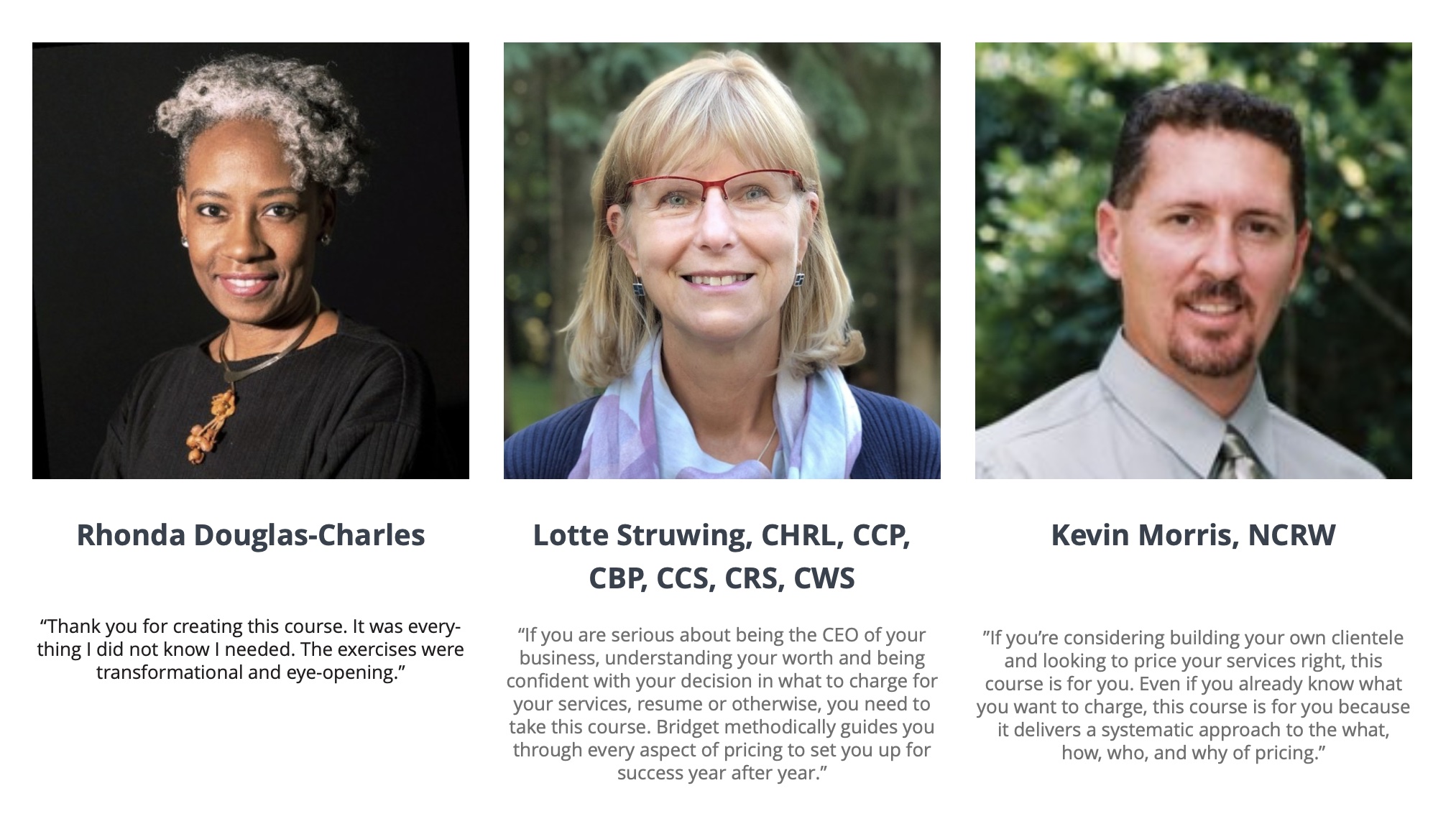
Here’s what colleagues have to say about the course:


But don’t wait to enroll. There are only 51 enrollments available during this special flash sale. Enroll now.

You can watch a preview of the course here:

PricingRight-Highlights

If you’ve ever struggled with pricing your career services (and let’s be honest … we all have!), this course is for you. Get the practical, actionable information you need to set your prices so you can hit your revenue goals the final three months of 2024.

Remember, this sale price is only available until midnight Saturday – and only for the first 51 career industry colleagues who sign up. Enroll here!


Monday, September 16, 2024

Mindset Monday: Have You Considered a Vision Board?

One of the ways you can increase your positivity and grow your success mindset is to create and use a vision board. A vision board is pictorial of the success you want to achieve. The main point is that you want the vision board to be easily visible and usable after it’s created. 

  • Know What You Want. The first course of action for you is to know what type of goals you are working on for your vision board. Some people like making an “overall” vision board that depicts their entire life, but it can also be helpful to create one for each individual goal that you have so that you can focus on one thing at a time. 
  • Set Your Goals and Objectives. When you know which life area you’ll focus on, write down your goals and objectives. Use the SMART goal format so the goals you make also have tasks and actions associated with them.  
  • Choose Your Tools. Now that you know what you are creating, choose the tools you will use. Plan to look at the vision board daily. It’s not going to do any good if you can’t see it when you need motivation. You can choose a print format or use a Pinterest board.
  • Choose Images / Words That Support Your Goals. As you choose the pictures and words that depict and support your goals, store them in one spot, such as Dropbox or a folder. Write down or copy words that help support your goals, too, because you’ll want to connect the images with affirmations too.
  • Design the Vision Board. Now that you have all the information and materials, start preparing your vision board. Focus on the feeling of meeting your goals. Feel it as you create it. 
  • Look at The Vision Board Every Day. Look at your vision board every morning before starting your day and even every night as you consider your actions and set up your day for tomorrow. The only way your vision board will help you is if it’s tied to the actions you take each day.
Finally, allow yourself to experience emotions about how you’re going to feel when you succeed by meeting that goal. 

Resume Writers & Estimated Taxes

If you’re a self-employed resume writer, then you are responsible for paying your own taxes. In contrast, if you work for someone else then taxes are automatically taken out of your paycheck. Depending on your annual income and your circumstances, self-employed iresume writers may be required to pay taxes on a quarterly basis.

Check with your accountant or refer to past tax returns to determine if you can pay annually or need to pay quarterly. There’s no disadvantage to paying quarterly. You can, on the other hand, be assessed fees if you decide to pay annually but earn too much (and should have paid quarterly).

The 1040ES is a form that will help you estimate your quarterly taxes. It’s available here –

https://www.irs.gov/forms-pubs/about-form-1040-es

You can also learn more information about quarterly tax payments and what is required here - https://www.irs.gov/businesses/small-businesses-self-employed/estimated-taxes

Once you know how much you need to pay every three months, it’s time to create a plan to save for it. This isn’t your emergency savings plan. This is a different savings plan designed to take the financial pain and stress out of paying your taxes.

Step One: Where Will You Save The Money?
Unlike an emergency savings plan, your tax savings doesn’t need to be stored in a separate account. If you keep good records you can simply keep your tax savings in your standard business checking account. If you believe you might be tempted to spend the money, then open up another savings account specifically for your quarterly taxes. 

Step Two: Weekly or Monthly?
The easiest way to build your savings is to establish automatic deductions. For example, you may have $500 deducted from your business checking account each month and added to your tax savings account. To determine how much to deduct, simply divide your anticipated quarterly tax payment by three months or 12 weeks.

If you are keeping all of your money in one account, you’ll want to make sure you build up the amount in your account on a monthly basis so when tax time comes around you have enough money ready.

Step Three: Add It to Your Budget
Treat your quarterly taxes as any other business expense and incorporate your monthly tax savings into your monthly budget. By doing this, you’ll make sure that you always account for the expense and never fall short. When tax time rolls around you’ll be stress free and in the black.

Saving for your quarterly taxes may not be fun, and there are certainly other things you’d like to do with the money. However, by creating your quarterly tax plan you will remove the stress of paying taxes and you make sure you’re not hit with a large payment (and possibly even financial penalties) at the end of the year.

Wednesday, January 17, 2024

Case Study: Shortcuts in Resume Writing


SHORTCUTS IN RESUME WRITING – A CASE STUDY

A client called me yesterday to tell me he had a first interview on Monday with one of his Top 4 Target Companies and that it went well. He’s been asked back for an in-person interview next week. 

There were a couple of tools I used on his project that were helpful “shortcuts.” This client isn’t my “ideal” client these days. (I work mostly with Marketing, Advertising, Public Relations, and Sales – or “MAPS” clients — but he was a returning client from 2014, so I was happy to work with him again.)

His previous resume (2014) had focused on his role as Warehouse Manager/Shipping & Receiving Manager (that resulted in him landing a job initially as Maintenance Technician with his current company). I did an update to his resume in 2016 for an internal role and he was promoted to Warehouse Manager. He was then promoted to QA Inspector/Lead Technical Writer (without a resume update). Unfortunately, last year his employer lost a major contract. He was given the opportunity to switch to a manufacturing position or be laid off. He decided to change to the manufacturing role (with a pay cut), but wanted to start looking for new opportunities. That’s when he reached out to me.

Quality Assurance is the focus for his current job search, but it required completely overhauling his resume. (Which was necessary anyway, with the 7-year timeframe between his last work with me and this job search.)

To gather information for his new career focus, I used one of Evelyn Salvador’s Career Worksheets. The “Documentation: Manufacturing and Production” worksheet provided insightful questions to gather information about his most recent relevant role (2019-2023). I provided him with a checklist to identify the keywords relevant to his experience, and incorporated some of the Documentation questions into my questionnaire. 

Once I had his information, it was time to tackle the resume writing. Lately, I’ve been starting the writing process by browsing Michelle Dumas’ Distinctive Resume Templates to find one that feels like a fit for the client, job target, and industry. I decided on the Blue Collar Resume Template (with Blue Collar Coordinating Documents – resume addendum, cover letter, and references templates). The templates are visually appealing and ATS-friendly and I find it easy to populate them (changing the color scheme with an appropriate color for the client — in this case, blue to denote “trust, security, and stability.”

I also had this client take a DISC profile assessment (I’m a DISC administrator through Jane Roqueplot and Profiling Pro), which I culled insights from to include in his resume. 

He used his new resume to apply to a handful of positions last week and got a call last Friday to set up a phone interview on Monday (yesterday). Because it had been a while since he had interviewed (especially for an outside role), I sent him a couple of resources over the weekend to help him prepare. One was my “Pre-Interview Worksheet & Checklist” (a Fillable Worksheet). I also sent him my guide to Virtual Interviews (based on this Pass-Along Materials document: Jobseeker’s Guide to Virtual Interviews). 

I had previously sent him my “Be the STAR of Your Career Story” worksheet to put together a couple of accomplishment stories while I worked on writing the resume. He reported back that he had used a story about reducing production time from three months per unit to three weeks and said the interviewers were impressed. 

In the phone interview, they basically offered him the job (they asked him how much it would take to get him to move on from his current employer), so his next step is doing salary research and prepping for the in-person interview. I’m going to be sending him some resources to help with that later today.

Resources mentioned in this case study: 
Evelyn Salvador’s Career Worksheets 
Distinctive Resume Templates 
(
➡️ use promo code 50offbearesumewriter on the Distinctive Resume Templates website to save 50% on your first purchase of any amount.) 
DISC Testing 
Tools for Job Search 
Pass-Along Materials Archive 2011-2020 

What did you think of this case study? Are
 there resources you use as shortcuts? What are they? Comment below!

Monday, January 8, 2024

Mindset Mondays: Exercise to Practice Gratitude


Practicing gratitude can go a long way to helping you feel happier and more successful in life. The most interesting thing about having a success mindset is that it is indeed a mindset. Studies have been done on numerous people throughout history that show that even people you may not see as successful can feel successful if they have the right mindset

  • Write It Down. Keep a small notebook by your bedside, your desk, or in your glove box. Whenever you feel a wave of gratitude, write it down. This helps you to remember the experience and even relive it when the need arises.
  • Record It. Almost everyone can record themselves today with smartphones and tablet computers. If you don’t want to write down your feelings, you can record them. Whenever you feel grateful, or need to feel it, make a short two minute recording to document it. 
  • Focus on It. Allow your mind to focus on all the gratitude you feel, but in a tremendous way. Amplify the feeling by describing it as fully as possible. How does your morning walk feel? How does your morning coffee smell? What do you feel when you watch your sleeping child?
  • Say It Aloud. Even if you’re not writing it down or recording it, you can still state your gratitude out loud. 
  • Feel It. Don’t just write down or record and state your gratitude. Take a moment to feel it. Focus carefully on how it feels to breathe in the fresh air, and take the moment in fully. Immerse yourself in the feelings as much as you can. 
  • Share It. When you are feeling gratitude, it’s a great time to tell others about it. When you share your feelings of thanks to the world either by calling someone and telling them that you’re thankful for them or by sharing on Instagram or Facebook or X/Twitter your gratitude, you’ll feel it more fully. 

Focus on what makes you happy and less on what makes you unhappy. It may seem silly, but it’s backed by science. Your thoughts control your feelings, and you control your thoughts. It’s that simple.

We’re expecting our first big snowfall of the season today … they’re saying 4-7 inches – so I’m going to be grateful for the moisture … and that Jon and I work from home! 

What are YOU feeling grateful for today? Comment below!