Tuesday, May 10, 2011

Five Quick Tips To Get Traffic to Your Resume Website

Online, one of the most significant keys to success is getting website traffic. The more visitors you have, the better your sales and profits. Presumably you have a niche for your resume writing service (executive, financial, IT)  and you know your keywords, and regularly conduct keyword research to stay on top of what's popular. Based on those assumptions here are five quick and easy tips to get website traffic fast!

Tip #1: Make sure you're actually tagging your keywords. Do you spend a lot of time optimizing your content and then neglect to tag them on your webpage? Tags are where search engines look and if there are no tags, they'll pass right by your web pages. Here's a quick brief on tags.

There are a number of tag types, including:
* Title tags. Title tags are quite possibly the most important place to situate your keywords.

Your title tag is where you place your primary keyword or keyword phrase. The sentence will describe your business in less than 90 characters.

* Header Tags. Header tags are next in order of importance to search engines. They're ranked in order of importance.

* Meta Tags. Meta tags provide the small descriptive text found underneath the title tag on the search engine results page. Like title tags these should be kept brief, informative and up to date.

* Alt Tags. Alt tags are used to provide a text description of a graphic. Each graphic on your site should have a description and an alt tag.

Tip #2: Add content to your site daily.Content is essential for traffic and a top search engine ranking. Content is what search engine spiders look for and index -- without it, there's nothing to index or rank. Give visitors and search engines a reason to visit and index your site. Make a commitment to provide daily, optimized content and your traffic will soar.

Tip #3: Procure valuable and relevant incoming links.
The more websites which link to your webpages, the more valuable search engines perceive you to be -- though not all links are created equal. Search engines give more leverage to links from sites which are popular and credible and from sites which are relevant to your website topic.

There are different types of links.
- A direct link looks like a basic website address, for example, www.yourwebsite.com

- A text link occurs when the webpage address is embedded in the text. Readers simply click on the link and are redirected to a new website page.

- If the link is to an internal web page, for example an article published on a website, rather than the home page, it is called a "deep link."

You can encourage linking to your website by:
* Adding content to your site.
* Submitting to article directories.
* Publishing press releases.
* Blogging and participating in social networking forums, chat rooms, and social networking sites.

Tip #4: Be Social!
Now more than ever before, Internet marketing is about building a community. Whether you offer a forum on your website or you participate in social networking sites, social networking is a valuable traffic generating tactic. Sites like Facebook and Twitter can be powerful tools for generating links and traffic to your site -- create a profile and then post comments, links to your site, and ideas which generate conversation.

Get involved -- many chat rooms and forums are industry specific (including those for job seekers), find those which cater to your industry, and begin participating. Speak to and connect with a highly targeted audience.

This is where most resume writers and career coaches stop. 

Tip #5: Advertise for more exposure and traffic.Advertising, when handled strategically, can be used to promote your content and products or services. PPC (Pay-Per-Click) advertising is often the tool of choice because you control the advertising budget on a daily basis and have the tools to test and track your advertising efforts. Once you've honed your PPC ads, the return on investment can be phenomenal in terms of traffic and purchases.

For maximum results, create a traffic and SEO strategy. Outline your plan and your goals and then take the necessary action. Take advantage of these five traffic and search engine tips to boost your business.

Monday, May 9, 2011

"Recalculating" -- Mapping Your Course to Success


I have that Allstate car insurance commercial in my head. You know the one (it's called "Mayhem is Everywhere") -- the guy is driving in his car and his GPS voice gives him wrong directions (including a quick "Turn right,") and he crashes into another car. At the end of the commercial, the guy playing the GPS says, "Recalculating." 

Isn't that what life is all about? Recalculating your path after you make a wrong turn -- or worse, crash? If I steer my vessel in the wrong direction, I can find a map and chart out a new course. Stopping is not an option. I will find my way as long as I keep my eyes on the prize.

Success is a journey, not a destination. Strive to make each step count. A positive attitude helps you move forward and, even when you are unsure of where you are, you are not lost. Instead, choose to become a trailblazer. The generation coming behind us will have access to another route thanks to our resolve to stay the course and forge a new path.

When you come to a fork in the road, trust your intuition to guide you. Being spontaneous in this way helps release your inner self and experience success in a new way. Spontaneity gives you freedom.

Missing a turn causes me no panic because I know that I have countless options; I am not limited to only one way. A wrong turn may lead me to find a new way. The opportunity to explore the unknown excites me.

Although it feels daring to get off the fast-paced highway of life and take the scenic route, detours can be worthwhile because they lead us to discover the beautiful things in life that we otherwise may have missed. The road less traveled is filled with the most stunning sights.

Flexibility allows us to prosper despite failure. Being flexible gives us the strength to keep going when we would rather stop.

Self-Reflection Questions: 
1. What do I do when I reach a dead end?

2. How might I become less rigid and more flexible?

3. What changes can I make to ensure that I enjoy the journey just as much as the end reward?

Tuesday, May 3, 2011

Reduce Your Stress: Get Organized!

Julie Walraven, of Design Resumes, had an inspiring blog post yesterday ("Why I Spent Saturday Shredding.") That's Julie on the left there, and her office does look pretty good (from what I can see of it in the photo...) I asked her for a before-and-after photo of her office, but she didn't take one, unfortunately.

I find disorganization to be stressful. Like many resume writers, I'm surrounded by paper. I like to be able to work from paper documents instead of computer files, so I print out lots of stuff -- the client's old resume, their questionnaire, research materials (from which I cull keywords), work authorization files, drafts. Ugh. I am surrounded by paper. (I'm surrounded by more of it than usual at the moment because my shredder died, and the plastic tote box that contains my current pile of shredding is actually too large/heavy for me to "tote" to my favorite office supply store to have it shredded!)


Seeing the piles of shredding -- along with all my normal paper -- is stressful!

When I'm not organized, I'm stressed. When stuff is piled everywhere, I lose or misplace notes. I would forget about meetings and I was notorious for losing receipts. All of this made my stress rise through the roof.

When you buy something and it doesn't work, you stress. THEN when you can't find the receipt....it isn't a good scene. That's happened to me a few times, I admit!


I've heard of a program called Evernote (works for the Mac!) that I'm thinking of trying. Currently, I'm doing a little better with my "overall" notes and thoughts by using an online website called "Workflowy." I'm still searching for a better way to handle the volume of paper that I seem to accumulate, but at least I know that I perform better when I take the time to organize. As the old public service ad says, "Knowing is half the battle!"

Is organization (or lack of) is one of your stress triggers? How do you handle it? What tools help you stay organized? (Are you one of those resume writers who prints everything out too?)

Tuesday, April 26, 2011

Introducing Online Manifesto for Biz


Running a business in today's technologically advanced world can be both exciting and extremely challenging. As a resume writer, you have all of the pressures of staying competitive within the careers industry while also staying current with the trends going on in society -- especially the trends in online marketing.

Having a properly planned and optimized web presence is no longer a nice to have. If you want to have long-lasting success as a resume business owner, your business needs to be online -- and it needs to be in all of the various formats of online exposure.

But how do you know where to start when there are so many components to online marketing and such little time to dedicate to it?

You start with a system. A system that has a proven track record and produces predictable results. A system that can be learned in steps and implemented in a realistic time frame. That is exactly the kind
of system that is being presented to you here today.

Introducing:


The Online Manifesto for Biz is a 21-step program that shows you the most critical components required to successfully bring your offline resume writing business FULLY into the online world.

With so many websites, social sites, and advertising platforms available for businesses to make their mark online, it is very easy to get lost and make costly mistakes.

The Online Manifesto has been designed to cut through the clutter, focus on what works, and deliver it to you, the REAL business owner, in a way that can be easily understood and implemented.

Here is an overview of what this system covers:

Web Basics:
Step 1 — Web Hosting

Step 2 — Domain

Step 3 — Web Platform

Blogging:
Step 4 — Why Blog?

Step 5 — Blogging Best Practices

Social Media
Step 6 — Setting Up Twitter

Step 7 — Using Twitter Properly

Step 8 — Facebook Profile & Fan Page

Step 9 — Facebook Places

Local SEO
Step 10 — What & Why

Step 11 — Keyword Research (Localized)

Step 12 — SEO Basics

Step 13 — Setting up Google Places

Step 14 — Google Places Best Practices

Mobile Marketing 
Step 15 — The Power of Mobile

Step 16 — Making Your Site Mobile Friendly

Step 17 — Mobile Marketing Options

Lead Capture
Step 18 — Lead Capture in a Nutshell

Step 19 — Lead Capture Best Practices

Media Buys
Google and Facebook Ads

Step 21 — Cross Promotion

If you purchase the Online Manifesto for Biz by Saturday, April 30, you'll pay just $7 (50% off the regular price of $14). You'll also receive the Best of the Conferences Special Report (an $8 value) as part of my Lent Special -- for free.

Friday, April 15, 2011

Guest Post: Avoiding the Hit or Miss In Your Business

Guest blog post from Monica Shah.


Recently, I wrote a blog post on the three numbers that you must track in your business.

I received this comment:

“Hey Monica, any advice for someone who’s already tracking revenue and expenses numbers, but it’s still hit or miss all the time? I used to avoid it, but now I’m avid about tracking it, yet my consistency doesn’t seem to be yielding the results I’d like .” – Angela Minelli

What an amazing question. This used to happen to me all the time. I would make clear goals, keep track of money and know my numbers, but I just wasn’t filling my practice, selling enough products, or filling my groups. Furthermore, bringing in consistent income was also incredibly hard. I found the whole thing royally frustrating. Now that my business has matured, I can clearly see what was causing these results. If you’re out there, creating your goals and dutifully following your numbers, but you still seem to be missing the mark, then I’d like to offer a 5-step clear action plan that will bring you more money and more clients.

1. Avoid “magical money thinking.” 
Figure Out Your Numbers. Let’s say you want to fill your practice with 10 new clients by the start of July. That means you need to get about 3 new clients every month. Please avoid assuming that if you think about that number hard enough or clear your emotional blocks long enough, the clients will just flow in – that is what I call “magical money thinking.” The first step is to make a clear action plan around how you are going to meet 3 new clients this month. It’s all a numbers game. Let’s assume for every 2 sales conversations, you sign one client. Let’s also assume that for every 3 people that you ASK to do a sales conversation with, 1 says YES. That means you need to get yourself out and about so that you can meet or interact with at least 18 people this month who you’ll ask to do a sales conversation with you. And you will do six sales conversations in order to hit your 3 client goal.

2. Create an action plan to connect with new people. 
Ok, now you need to decide how you are going to meet at least 18 people new people this month. Don’t worry, it’s not as hard as it seems. First start with follow-up from your own list and other business events that you haven’t done yet. This is what I call a low-hanging fruit list. Make a list of people that you can contact that you’ve already met or who have expressed working with you in the past. Ask them to do a free meeting or initial session with you. Let’s say you find 3 people to ASK.

Second, plan your networking events. Let’s say you meet on average 4 people at each networking event. That means you’ll need to go to at least 3 networking events this month. That is 12 new people to ASK.

Third, plan a workshop. Let’s say you get an average of 3 free initial sessions after you do a workshop. That means you’ll do 1 workshop this month. That is 3 new people to ASK.

Now you know how you are going to meet your 18 new people to connect with this month.

3. Calender Your Events. 
This is the most important step. Now find 3 real networking events and put them on calender ahead of time. It may be helpful to put six on the calender, just in case you can’t make some of them. Also, locate a place to do a workshop on your topic area and get that on the calender. Commit to these events. No getting tired or shy when the day comes to put yourself out there. The more consistent you get about doing this kind of plan and actually following through on it, the more consistent your income will be.

4. Follow this Plan, no matter how advanced you are in your business. 
For those of you out there that are planning group program launches, product launches and the like. You can use this same plan. Here are the differences. For a launch, you want to start planning 8 weeks out from the launch. That way you can get your copy written and get the pages up on time. Next, use the same steps to determine your numbers. In this case, you want to add some online joint ventures, social media marketing and teleseminars to your connecting efforts. I think it is important, especially for new business owners with small lists, to combine offline marketing like networking and workshops with online marketing like teleseminars and joint ventures. You’ll connect with more people that way. Put everything on the calender and stick with it.

5. Stick to the plan. 
Please realize that consistency is important. The first time you create an action plan like this, it may not work so well the first month, even though you follow it to a T. However, by the third month, seeds that you planted in the first month will start to sprout. This is even true with your first launch of a group program or product. Sometimes it takes two times through before people start to notice you. Just stick with it – consistently making action plans and following through on them. When I do a VIP day with my clients, where I work intensely with them for 6 hours, we create a 12 month action plan so that they know exactly what to do each day, each week and each month. I highly suggest everyone has a plan that they are following that goes out at least 60 days.

As you can see, knowing the numbers is only 50% of getting results. The other 50% is creating a smart action plan and sticking to it. I hope this helps you to see specifically HOW you start to create such a plan. Leave me a comment and let me now how this lands with you.


Monica Shah, MBA, is the Breakthrough Business Specialist. Her M.O.R.E M.O.N.E.Y system effectively teaches women to take their passion-based business to six figures and beyond. Would you like to learn how to run a business that you love while creating the lifestyle you deserve? Check out her website http://www.RevenueBreakthrough.com, for free articles and resources and to sign up for her free report "5 Simple Steps to Double Your Income in 60 Days or Less."

Wednesday, April 13, 2011

Advantages of Blogging -- Part III

The first two posts in this series outlined the advantages of a blog to drive traffic to your website and helping brand you as an expert.

The third advantage has to do with your website making you money directly.

3. Money making potential: There are going to be lots of people who come across your blog who don't turn into resume or career coaching clients. You can make money from your blog by getting them to purchase your affiliate offers -- but you can also make money from them just by virtue of them visiting your site -- through advertising revenue.

If you are getting a lot of traffic to your blog, you can sign up for a service like Google AdSense which will place relevant ads on your blog posts.  Every time a person clicks one of these ads you will be paid.  There are also tons of affiliate offers out there.  On a site like Clickbank, you can sign up and promote other people's products on your site.  This works especially well if the product is relevant to your content. 

You might even get the opportunity for selling your own ad space. You can sell ads directly on your blog -- you might partner with a local service provider (for example, a mental health therapist who offers career assessments) and sell them ad space on the blog.


Blogs have moved beyond the realm of an online diary and yes it seems like everyone has a blog.  Those aren't reasons for you not to do it, especially if you want to succeed as a professional resume writer and/or career coach.  More traffic, brand yourself as an expert and make some money...who wouldn't want that?


Tuesday, April 12, 2011

Advantages of Blogging -- Part II

In yesterday's blog post, we looked at the first advantage of blogging, feeding traffic to your resume writing or career coaching business website.

The second advantage has to do with positioning yourself as an expert.

2. Brand yourself as expert on a topic:  This is also a great benefit for professional resume writers and career coaches.  If you are constantly blogging helpful advice about a certain topic -- you will eventually begin to gain followers.  If your information is high quality, people will begin to look at you as an authority on your subject. Once you are looked at as an authority on the subject, you will instantly gain the trust of your blog readers.  They will come back and be loyal visitors.  Loyal visitors means you can funnel them to become clients or even tempt them with affiliate offers.


Next up in the series: Making money directly from your blogging efforts.

Monday, April 11, 2011

Advantages of Blogging -- Part I

For a resume writer or career coach, there are a number of advantages to having your own blog. Lots of people have blogs -- they're used for online marketing (promoting your resume writing and career industry services) by small business owners (just like you!). There are also a number of "hobbyist" blogs out there, focusing on specific niches -- giving you the opportunity to connect with other blog publishers (and drive traffic to your own blog!)


Despite what many people think, blogs aren't just "teenage diaries." While there are a number of blogs out there these days in the career industry field, the market certainly isn't saturated.  Competitiveness in a market just means there is traffic to be had and money to be made...if you want it.


Creating a blog in this day and age could not be easier.  There are literally hundreds of completely free blogging platforms available to people.  So why not give it a shot? 


If you are shaking your head right now thinking about how you said you would never blog, check out these three advantages. We'll look at advantage number one in today's blog post:


1. Feed traffic to your resume writing business website:  If you have a website for your career industry business (resume writer, career coach), adding a blog to that site or even on its own domain is a smart move. 

Blogs are based on dynamic content -- meaning the content is fresh and regularly added.  Google likes fresh dynamic content.  If you are blogging constantly about things related to your business you will naturally begin to start ranking in Google for some long tail keywords. This means you will be picking up web traffic that your static business site wouldn't have.

If your blog is part of your business site then that will mean more traffic directly to your site.  If you have your blog on another domain -- you can use links and banners to direct the traffic to your business or "money" site.


Tomorrow: Using a blog to showcase your expertise.

Saturday, April 9, 2011

Resume Writers Digest Receives CMA Mentorship Award!

I found out on Thursday that I received a Career Management Alliance Mentorship Award!


Thanks to Kathy Hansen for nominating me for this award. I'm truly honored. Here is the criteria for the award:
The Career Management Alliance honors those individuals who have guided others in tradecraft, entrepreneurship, and community-building. Through teaching and example these mentors have inspired their colleagues and generously shared their wisdom.


Kathy's nomination (which she so kindly sent to me), was centered around my efforts to educate and inform resume writers through the work of Resume Writers' Digest -- including this blog. So thanks to all of my readers and subscribers too!

Thursday, April 7, 2011

Using Social Networking to Promote Your Blog

Promote your blog? Why would you want to do that? Honestly, if you have to ask yourself that question you probably shouldn’t even have one. The whole purpose of a blog is to document your thoughts, views, and opinions on a particular topic, issue, or subject -- on our field, most likely job searching. What good will your blog do if no one reads it? In addition to sharing your thoughts with the rest of the world, did you know that you can make money from your blog? You can signup for affiliate programs or derive revenue from advertising programs like Google Adsense. And, of course, prospective clients who read your blog may decide to retain you to write their resume. If you are using your blog to make money, then you will defiantly want to promote it.

When it comes to promoting blogs, there are many blog owners who decide to let search engines do the work for them. Search engines, such as Google, Yahoo, and Bing use a special technique that reads the content on your website. That content is then used to rank your website with particular keywords. This means that you run a blog on job searches in the finance field, there is a good chance that your blog will appear in searches done on "finding a job in finance." Although many blogs are successfully ranked in search engines, not all are. That is why you are advised against relying solely on search engines, when it comes to promoting your blog.

If you love meeting with or talking to people online, there is a good chance that you belong to a social networking website or community. The individuals that you talk to and that are in your community are likely the individuals that you wish to target. Since most social networking websites work to connect Internet users who have the same goals and common interests, there is a good chance that your online friends will enjoy reading your blog. But, before they can read your blog, you have to let them know that it exists.

When it comes to promoting your blog on social networking websites, you have a number of different options. Your first option is to include a link to your blog in your community profile or profile page. This will allow other community members to check out your blog. The other way is to inform your online friends of your blog through private messages. Once you join a social networking website and create or join a network of friends, you should easily be able to communicate with those friends. Sending each of your friends a private message with information and a link to your blog tends to be more effective than just placing a link in your profile or on your profile page.

Wednesday, April 6, 2011

How to Use Social Networking To Draw Traffic to Your Website

Social networking websites can benefit all website owners, but especially resume writers who are looking to make a profit from visitors to their websites. This can be done one of two ways -- by selling something on the website (resume writing services, career coaching, job search packages, or affiliate products) or by relying on revenue from advertising (a handful of resume writers run websites that provide job search content supported by advertising revenue). 

If you have a website that selling products or services (as opposed to a content site that depends solely on advertising revenue), you may find it a little bit easier to use social networking sites to your advantage. This is because, if you wish, you could do product or service spotlights. Each day, week, or month, you could showcase one of the products or services that your website sells. This could either be done through status updates, Tweets, or blog posts. 

If you are using your online website to make money with advertising programs, such as affiliate programs or Google Adsense, you may need to approach social networking websites in a different matter. Since you will not necessarily have a particular product or service to focus on, you will need to approach these websites as if they were personal websites.

As with all other types of online websites, social networking websites should help to increase the number of page views your website receives. In most cases, more page views mean more clicks -- which means money for you.

Saturday, April 2, 2011

Getting Ebook Ideas from Magazines (Third Part in a Three-Part Series)

This is the third post in a three-part guest series of articles by Jimmy D. Brown. This post focuses on getting e-book ideas from magazines... using Magazines.com.

After visiting the world's largest search engine and the world's largest bookstore, it's time to take a quick stop at the world's largest periodical store, Magazines.com.

You'll find every imaginable magazine listed at this site. The interesting part (and useful to you as a research tool) is this: you'll also find the COVER of usually a recent copy of each magazine.

There aren't a ton of magazines (any??) geared towards the job search, but browsing through the categories of magazines on the site, you can find some magazines that will spur some ebook ideas. For example, looking through the "Women's" category, I came across "Working Mother" with this cover tease: "Get That Job: Surprising Interview Tips." Your ebook could be on "Surprise Your Job Interviewer With Your Preparation" and it could cover how to research the interviewer and the company using free Internet resources.

Each of the "cover stories" you find represent an idea for your next ebook.

The best part about it is this: the publishers of these magazines have done the research for you! They've measured the level of interest for these ideas and found it high enough to warrant not only writing content about them, but referencing that content on the cover of the magazine!

That's your hint: People want this information.

So, there you have it in this blog series -- three "idea hangouts" where you can find ready-made, in-demand, red-hot topics for your next ebook for your job seeking clients.

Happy hunting!

----------------
Jimmy D. Brown is the author of, "5 Keys To A Big-Profit, 
S.M.A.L.L. Reports Business."  To download your free copy, 

Friday, April 1, 2011

Using Amazon Affiliates to Generate Additional Income

A few weeks ago, I put together a five-part series on affiliate marketing for resume writers. Another source of affiliate income is with Amazon Affiliates.

I suggest you set up an account with Amazon Affiliates and build a “Recommended Resources” page on your website, featuring links to books that you’re featured in, that you’ve written, and/or that you’d recommend to clients. While this isn’t a large income source, you are doing clients a favor by offering your recommendations, and any sales you make are gravy. 

You can also use your Amazon Affiliates link to include book links and graphics in your blog posts, especially if you use Blogger. I’ve found my top two book recommendations that have led to sales are Jason Alba’s book, “I’m on LinkedIn, Now What?” and “Career Distinction,” Kirsten Dixson and William Arruda’s book on personal and career branding. 

I also used to sell a couple of copies of “The Insider’s Guide to the World of Pharmaceutical Sales,” but that hasn’t been published in a few years. 

If you have a blog geared to job seekers, I’d recommend doing regular book reviews — review books you’ve read and then include links to your Amazon Affiliate site. 

You can also excerpt your reviews on the book’s page on Amazon directly, which will help increase your “Digital Distinction” rating — and if you don’t know that that is, you should read Career Distinction.

Thursday, March 31, 2011

Getting E-Book Ideas from Amazon (Second in Three-Part Series)

This is the second in a three-part series of blog posts designed to help you get ideas for e-books to supplement your income as a resume writer. The first post in the series focused on Google.

Next up: Amazon.com

From the world's largest search engine we move to the world's largest bookstore.  At Amazon.com you'll really get your creative juices fired up.

Again, you'll want to search the listings by entering a keyword or keyphrase into the search box on the main page at Amazon.com.

You'll get a returned listing of numerous books, courses and other periodicals. Search these listed items for ideas for your own ebook.

--- Example ---

If you were to search for "Job Interview," you'd find a variety of ideas just waiting in the listing of books 
available, including: an ebook with common interview questions & answers, how to research an employer before a job interview, preparing for an interview using LinkedIn, creating a portfolio to use in a job interview, preparing for a virtual job interview (Skype, by phone, etc.), and avoiding the most common job interview mistakes.

Any of these ideas (and the dozens of others listed) would be great ideas for the topic of your next ebook.

Pay particular attention to the first page of the listing.  Amazon ranks their listings based on popularity of actual sales volume.  In other words, #1 is a better seller than #50.  This is a ready-made indicator of demand!


----------------
Jimmy D. Brown is the author of, "5 Keys To A Big-Profit, 
S.M.A.L.L. Reports Business."  To download your free copy, 
-------------------

Wednesday, March 30, 2011

Career Directors International Global Career Empowerment Summit 2011

Just saw the e-mail from Laura DeCarlo announcing the lineup and speakers for the CDI annual conference ... ahem ... I mean the "Global Career Empowerment Summit 2011," scheduled for Oct. 20-22, 2011 in Savannah, Georgia!

Once again, CDI has put together an impressive lineup of topics and speakers. You can learn more here.

Just a few of the notable subjects being covered:
  • Magic Bullet to Six-Figure Success: Strategies in Packaging & Pricing (panel)
  • Your Clients Are Leaving You! How to Win Over and Keep a Transient Audience (with Tim Tyrell-Smith!)
  • The Bullet Train to Job Search Success: Best in Class Online Identity Model (with Susan Guarneri and Laura DeCarlo)
Plus, they offer 3-, 5-, and 7-month payment options (as low as $77/month!)


I have to say, I loved Savannah when I was there a few years ago. Be sure to come in a day early and head up to Hilton Head Island. It's gorgeous. You may also find cheaper fares by flying into Jacksonville, FL. That's what we did, and then just drove up to Savannah.

Tuesday, March 29, 2011

Getting E-Book Ideas (First in Three-Part Series)

This is the first in a three-part guest-author series on coming up with ideas for e-books. Resume writers who only trade their time for dollars (the "time-for-dollars trap!") are missing out on the opportunity to made additional income. The blog post series is by Jimmy D. Brown.

I've always been impressed with those who seem to always be ahead of the pack when it comes to new ideas.

When I first started publishing information products online, I thought that certain people had a crystal ball they gazed into.  Or some top-secret contact who was providing them with inside information.

Over time, I realized that it wasn't magic that allowed these people to come up with red-hot ideas on demand.  It was simply that they knew where to look.

I soon discovered many places where ideas seemed to always be found.  I call these places "idea hangouts."  In this blog series (this is the first of three posts), I'd like to share three of my favorites "idea hangouts" where you can find ideas for your next ebook anytime you want.  Almost like a genie granting you three wishes...

Today's blog post focuses on Google.com.

Google is the ultimate "idea hangout."  There are so many ways to mine the gold in Google's amazing search database that it would take another article to graze the surface of this enormous iceberg.

What I want to mention are just two quick ways to find ideas by searching Google.

- Identify Listings.

Search for a broad topic related to your area of interest or expertise  (i.e., "resume writing" or "job search" or "job interview"). Look at all of the web sites listed in the index of returned results.  You'll likely find some ideas for information products right there in the first couple of pages.

Here's some e-books I came up with when I Googled "job search":

  • "Find a Job Faster Using Job Boards"
  • "Ten Tips for Getting a Federal Job"
  • "Using Social Media to Find Your Next Job"
  • "How to Successfully Change Careers"
  • "Find Your Next Job Using Craigslist"

- Identify Advertisers.

You'll probably notice small ads on Google -- either at the top of the page or to the right of the page (or both!).  These advertisers represent your competition.  They also represent your thermometer for taking the temperature of your market and gauging interest in specific topics. Chances are, what they're selling, you should be selling.

In both of these examples, you can click through to the web pages of the sites listed and study their respective sales pages.  Look specifically at the "bullet points."  Each of these represents a potential idea for your next ebook.

Here were some of the products/services being advertised with "Job Search" on Google:


Next up: Getting E-Book Ideas from Amazon.com (Part two in a three-part series.)

----------------
Jimmy D. Brown is the author of, "5 Keys To A Big-Profit,
S.M.A.L.L. Reports Business."  To download your free copy,
visit http://www.SmallReportsFortune.com.
-------------------

Friday, March 18, 2011

Five-Part Series on Affiliate Marketing: Promotion

This is the last post in a five-part series on affiliate marketing. The fifth thing you need to make affiliate relationships work is a promotional plan. 

Banner ads and text links are the two most common ways to promote your affiliate relationships. You can use these in a variety of formats. Using an e-mail list to sell the product is also a great way to promote your affiliate links (see the first post in the series, on list-building). Less common are print pieces.

As I talked about with steps 1 and 2 — building your list and developing additional online venues to showcase your affiliate relationships, you’re likely to generate little or no affiliate income if you don’t have a promotional plan in place.

For example, if you have a website, blog, and e-newsletter, you want to develop a schedule for when you will promote which affiliate relationships, and in which medium. You might have a banner ad on your website, which stays pretty constant over time. You might decide to run an ad in your e-newsletter every issue. But you should also plan your content. For example, writing an article on using the product or service for your blog and then excerpting pieces of that article in a couple of issues of the newsletter. If you don’t plan this out ahead of time, when it’s time to put your newsletter together, you might forget to include the ad and/or excerpt.

You can expect some support from your affiliate marketing partners when rolling out your promotional plan. Many of them offer pre-developed “creative” -- which is basically the “artwork” you’ll put on your blog or website. This is often in the form of customized code that you can copy-and-paste into your website code or onto your blog. Some offer affiliate newsletters, which alert you to new offers they are promoting, or provide you with articles that you can customize for your customers.

Some affiliate programs offer contests and other special bonuses. For example, last year, Ellen Britt, of Marketing Qi (pronounced “CHI”), who offers information products for social marketing, had a promotion for her affiliates called a “Ice Cream Social Media Sale.” She put together a package of information products from herself as well as a couple of other social media gurus and offered it over a multi-day promotion. You could purchase it for as little as $57 the first day, and it went up each day, until on the last day, you could purchase the same package for $197. She mobilized her affiliates to promote the program, offering them 50 percent commission on the sale … but also offered a couple of additional prizes. The affiliate that sold the most packages received one day of hands-on training with Ellen in Atlanta (it included one night’s lodging at a resort, but the winner had to pay his or her own transportation), and the second prize was an ice cream maker. You can see this promotion at http://icecreamsocialmediasale.com/.


You might also get ideas on how to market your products and services from the affiliate advertiser. Some will provide you with case studies of their most successful affiliates. Others offer tutorials or videos.

Thursday, March 17, 2011

Five-Part Series on Affiliate Marketing: The Agreement

It’s important to have a formal agreement, which is the fourth thing you need to make your affiliate marketing relationships work. 

It’s important to understand what your rights and obligations are. Some affiliate marketing relationship agreements are only a few paragraphs long. Others are pages. One is not necessarily better than the other. What is more important is clarity. Do you understand what you can — and cannot do — to promote the relationship? Do you understand how, and when you will get paid? Is there anything prohibited by the arrangement? 

For example, some affiliate programs (like domain name registrar 1and1.com) will allow you to use your own affiliate link to purchase products and services, and you’ll get paid on the order — basically, giving you a discount. Others strictly prohibit you from using your own affiliate code. AdSense, for example, will kick you out of the program if they find that you click on the ads that appear on your content, because this artificially inflates the income you receive from the advertising program. It’s important to know this!

Payment is also an area that isn’t often examined too closely by resume writers and career coaches. You might be thrilled to learn you’ve earned a couple of 30% commissions — until you see that the payment is still “pending” in your account. It’s one thing if your payment was just held up a bit while you submitted a tax identification number form to the affiliate network — it’s quite another if the affiliate provider has a $250 payment threshold…and you earn about $25 per month. Do you want to wait almost a year for your payment?

So there’s a balance. You might choose to affiliate with an independent program that pays a healthy commission on a regular basis — OR you can choose to go with an affiliate network that offers multiple affiliate opportunities, but at a smaller commission, because it’s easier for you to hit the payout threshold if you’re promoting multiple products.

The fifth, and final post in this series: Your promotional plan.

Wednesday, March 16, 2011

Five-Part Series on Affiliate Marketing: What Not to Promote

This is the third article in a five-part series for resume writers interested in affiliate marketing.

A key part of the affiliate marketing process is an understanding of what you want to promote and not. This is the third thing you need to make affiliate relationships work. There are certain things that you should not be promoting. This brings us into the discussion of what you shouldn’t be selling.

For example, have you ever visited a resume writer’s website and he or she had Google Ads on the home page — and the ads are promoting low-cost resume writing services? (I tried finding an example for this blog post, but fortunately, the majority of resume writers realize this is a huge "no-no.") If you do use Google Ads on your site, did you know there is a setting you can adjust on Google AdSense to eliminate your competitor’s ads from being shown on your content?

However, if you’re looking for complete control of what appears on your website and/or blog, don’t affiliate with Google AdSense. Even though you can exclude direct competitors, you still can’t control exactly which ads, from which companies, will appear on your content.

When working as a direct affiliate (that is, not just hosting ads on your blog or website or in your newsletter), you don’t want to promote any product that you don’t have personal knowledge or experience with. After all, as an affiliate, you are basically endorsing these products. You are staking your reputation on the products and services you choose to affiliate with. One definition of the word affiliate is: A company in which another company has a minority interest; more generally, a company which is related to another company in some way. So when you become an affiliate of a company, you are tying your brand to their brand. This is why it is important to carefully consider which products and services you choose to promote.

Tuesday, March 15, 2011

Five-Part Series on Affiliate Marketing: Your Online Presence

The second step in developing effective affiliate relationships is having a website, blog, or online presence. 

E-newsletters are nice, but you’re not going to get everyone to opt into receiving your e-newsletter. So if you don’t have some other online presence — and most often that is a website or blog — you’re missing out on the opportunity to talk to non-clients — or prospective clients — about your services — but also your affiliate marketing services.

The same content-to-advertising ratio used in e-newsletters applies to your website and blog. Make sure you’re providing useful content in both of these forums — and don’t­ let it overshadow your primary marketing focus — whether that’s resume writing or career coaching.

And make sure you disclose your affiliate marketing relationships. (But that's a whole other blog post!)

Monday, March 14, 2011

Five-Part Series on Affiliate Marketing: Your List

This is the first in a five-part series on Affiliate Marketing, building on our "Introduction to Affiliate Marketing for Resume Writers" post last week. The first post focuses on your list.

Those in the affiliate marketing world believe the list is the Holy Grail. But it’s not just the size of your list that matters. Frankly, the quality is more important. If I gave you a phone book, you’d have a list. But it wouldn’t necessarily guarantee you any sales, whether for resume writing or affiliate marketing products. Sure, you could probably get 1% of the folks you contacted to buy, but the return on the time and money you’d have to invest to make that happen probably wouldn’t justify the effort.

On the other hand, what if you could get 20% of your existing resume clients to purchase a resume distribution service or recruiter targeting service?

A few years ago, I conducted an interview with Steve Shellist, of ResumeSpider, which bills itself as the “E-Harmony” of job search. He gave this example of the kind of revenue that a resume writer could expect promoting ResumeSpider:

If you write 5-7 resumes per week, and convert 5-6 of them each month to become ResumeSpider clients, you will earn $100 to $120 per month (based on a $65 average sale price, resulting in a $20 commission per order). But remember, they don’t have to be one of your clients to be a client of ResumeSpider — meaning, every visitor to your website is a potential sale. You can easily double your affiliate profits if you have a web site that gets decent traffic and you promote ResumeSpider visibly to visitors.

If you’re the type of writer that generates a resume each day (and/or you get 5-10 job seekers looking at your website each day), you could conceivably convert 20% of them into affiliate marketing product users … and you’d make that $100 per month goal.

Next up in the series: Establishing your online presence.

Thursday, March 10, 2011

Finding Strategic Partners and Referral Relationships


Have you considered cultivating referral relationships with other service providers? These can be providers who write resumes, provide career or interview coaching, career testing services, or life coaches.

When choosing possible partners, look for individuals or companies that share a similar work style. Get to know enough about them that you would feel confident in recommending them to your clients.

In this blog post, I’m going to focus on how this process applies to selecting resume writers to partner with, but the process is the same for whichever type of provider you’re interested in working with.

The two most important factors when selecting a referral partner are whether they can do a good job and whether they can handle your clients well.

The process starts with identifying likely candidates. There are lots of options -- local providers, regional or national providers; direct competitors; colleagues.

The obvious choice is to look in the Yellow Pages or online listings. But don’t stop there -- you can also find possible candidates through networking in local professional associations -- Society of Human Resource Management chapters (for example, mine is the Human Resource Association of the Midlands). Depending on where you live, you may also have local associations of resume writers — for example, the Resume Writer’s Council of Arizona.

The advantage of working with existing résumé writers or career coaches in your local areas is that you can meet them personally and observe their operations firsthand.

Most of the service providers you consider will probably already be in business. They should have existing business structures — phone, computer skills, recordkeeping systems — to handle referrals you send their way. If they’ve been around a while, they probably don’t need much hand-holding either — which means you could set up a partnership agreement pretty quickly.

On the negative side, these are usually your competitors — meaning your prospective client may have already contacted this person or company and decided not to work with them, for whatever reason. So then you’re put in the position of “selling” your competitor to the prospective client, which may or may not work.

Are you interested in pursuing a strategic partnership or referral relationship? Purchase the "Developing Strategic Alliances and Partnerships with Recruiters" special report from Resume Writers' Digest.

Wednesday, March 9, 2011

Lent Special: Best of the Conferences Special Report


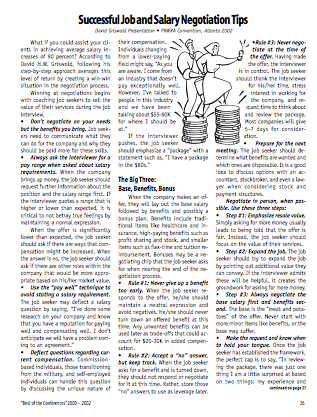
During Lent, I'm offering a special bonus for any Resume Writers' Digest purchases made. You'll receive a free copy of my "Best of the Conferences: 2000 to 2002" special report.

Here's the description of the report:
60-page report; delivered electronically. Contains summaries of the sessions from the 2000 PARW Conference in Toronto, the 2001 NRWA Conference in San Antonio, the 2001 PARW Conference in St. Petersburg, the 2002 CMI Conference in San Diego, and two career-related sessions from the 2002 AJST conference in Orlando. Great information on marketing, pricing your services, add-on services, sales techqniues, and great resume writing tips from Jan Melnik, Louise Kursmark, Wendy Enelow, Susan Britton Whitcomb, and more.

See below for a half-dozen screen shots of the great (and timeless!) information included in the report:


This special offer is valid only until Saturday, April 23 at midnight. When the Easter Bunny arrives, this offer disappears.

Within 48 hours of your purchase, you'll receive a separate e-mail from Resume Writers' Digest with your gift.

You can view actual article samples in this 12-page "Best of the Conferences Preview" issue I had put together as a special bonus in 2008. 

Just want to buy the report, you can do that too! Here's the link.
It's on sale during Lent too -- just $8 for immediate electronic download.

Questions? E-mail editor(at)rwdigest.com.